
Focus: On God’s Faithfulness
Some planted. Some watered. God gave the growth.
Scripture Covered: 1 Kings 3:9; 1 Corinthians 3:5–9; Matthew 20:20–28; John 13:1–17
Key Verse: “I planted, Apollos watered, but God gave the growth.” — 1 Corinthians 3:6
Our story at Quaboag Church has been unfolding for decades. People faithfully planted when this church began more than 35 years ago. Others came behind them and watered what had already been planted. Through changing seasons, leadership transitions, discouragement, COVID, new ministries, baptisms, discipleship, and growth, different people have played different roles.
But Paul reminds us of something we can’t forget: God gives the growth.
Faithfulness in Every Season
There have been seasons at Quaboag when growth was easy to see. Other seasons have required faithfulness to keep planting and watering what God put in front of us.
COVID was one of those seasons. Ministries emptied almost overnight. There were Sundays when our children’s ministry barely had any children. We didn’t know what the future would look like, but we could still be faithful. We could pray, prepare, renovate, rethink ministry, and keep planting.
That same pattern has continued throughout Quaboag’s history. Faithful people have served, prayed, led, taught, sacrificed, and prepared the way for those who would come after them. Some planted. Some watered. God gave the growth.
Jesus Defines Kingdom Leadership
As Quaboag has grown, we’ve focused not just on growth, but on becoming the kind of church Jesus has called us to be.
In Matthew 20, Jesus confronted the disciples’ desire for position and influence by completely redefining greatness:
“Whoever wants to become great among you must be your servant.”
Jesus wasn’t consulting on organizational strategy. He is the Savior who came “not to be served, but to serve, and to give his life as a ransom for many.” Our service is a response to his sacrifice.
Then, on the night before the cross, Jesus made that teaching visible. In John 13, the Teacher and Lord knelt down and washed his disciples’ feet. Afterward, he told them that he had given them an example to follow. Jesus both taught and modeled that Kingdom leaders use their influence to serve others, not themselves.
That conviction has shaped Quaboag for decades and continues to shape the way we lead today. One of the ways we live it out is by giving ministry away by trusting faithful people to use the role God has given them to serve others.
Leaders Aren’t the Hero
The church in Corinth struggled with attaching too much importance to particular leaders. Some identified with Paul. Others with Apollos. Paul’s answer was to put every human leader back in the proper place:
“What then is Apollos? What is Paul? They are servants through whom you believed.”
Each had a role. One planted. Another watered. Their contribution mattered, and Paul even says each would be rewarded for their work. But neither one could create life. Only God does that.
We’re grateful for the founding members who planted and for Dean and Terri and the years they invested here. We’re also grateful for staff, elders, deacons, leaders, and volunteers who continue faithfully planting and watering.
But leaders aren’t the heroes of this story. Jesus is.
Our Story Is Still Being Written
Some of us have been here long enough to see growth in things that were planted years ago. Some of us are watering what someone else planted. Others are newer to Quaboag and are still discovering the role God has for them here. Whatever season you’re in, remember: our responsibility is staying faithful to plant and water. Growth belongs to God.
That’s why celebrating what’s happened at Quaboag isn’t a celebration of Quaboag Church. It is a celebration of God’s faithfulness!
And now we get to ask together: What’s next? Join us next Sunday for that!
This Week’s Challenge
Take time this week to recognize where you have seen God’s faithfulness and thank Him for the people who planted and watered before you.
Reflect
Where is God asking you to faithfully plant or water while trusting him with the growth?
Dealing with Doubt
This week, we tackled a question every believer faces at some point: “How do I deal with doubt?” Whether it’s a quiet question that keeps us up at night or an unexpected challenge to our beliefs, doubt is something we all encounter. But what if doubt isn’t a sign of weak faith—but an opportunity to grow deeper roots?
Doubt Is Normal—And Can Even Be Healthy
Jay opened with a powerful reminder: “Doubt is normal. We all have doubts, and it’s okay to have those doubts.” Even some of the greatest heroes of Scripture struggled with doubt. John the Baptist, who boldly proclaimed Jesus as the Lamb of God, later sent messengers from prison to ask, “Are you the one who is to come, or should we expect someone else?” (Matthew 11:3). Thomas, forever known as “Doubting Thomas,” refused to believe in the resurrection until he could see and touch the risen Jesus himself (John 20:25).
Yet Jesus didn’t rebuke John or Thomas for their questions. Instead, He invited John to consider the evidence—“Go and report to John what you hear and see” (Matt 11:4)—and welcomed Thomas to see and touch His wounds (John 20:27). Their doubts didn’t disqualify them. Instead, their honesty led to a deeper encounter with the truth.
“Faith is not the absence of doubt. Faith is trust despite the doubt.”
The Real Danger: Doubt Left in the Dark
Doubt itself isn’t the enemy. How we respond to it makes all the difference.
Jay reminded us of the serpent’s question in the Garden: “Did God really say?” (Genesis 3:1). Satan still uses doubt to sow confusion and distance us from God. But the answer isn’t to hide our doubts in the shadows. “I want us to grab our doubts kicking and screaming and drag them into the light,” Jay said. “The darkness is where Satan is. We can’t fight our doubts in the darkness, in the shadows. We’ve got to bring them out.”
This means voicing our questions, seeking wise counsel, and—most importantly—testing everything against God’s Word. As Acts 17:11 commends, the Bereans “received the word with eagerness and examined the Scriptures daily to see if these things were so.”
Two Reasons to Test Our Doubts
1. To protect ourselves from deception.
Jesus Himself warned us: “Watch out that no one deceives you. For many will come in my name... and will deceive many” (Matthew 24:4–5). In a world full of confusing voices, testing what we hear against Scripture keeps us grounded in the truth.
2. To be ready to share the reason for our hope.
1 Peter 3:15–16 calls us to “be ready at any time to give a defense to anyone who asks you for a reason for the hope that is in you. Yet do this with gentleness and reverence.” We may not have all the answers, but we can point to the One who is our hope—Jesus.
“My very favorite thing to tell people is, I’m just a beggar who found bread, and I want to introduce other people to the source of that bread. That’s it. That’s the gospel in a nutshell.”
Cultivating Deep Roots
So how do we deal with doubt in a way that leads to growth instead of discouragement? Jay offered practical steps:
- Open your heart to seek answers and wise counsel.
Don’t isolate. Surround yourself with people who love God and can help you process your questions honestly.
- Use Scripture as your standard.
“Don’t believe anything I say. Don’t believe anything you see on YouTube. Go back to Scripture, search it. What does it say? It’s a love letter from your Father. Read it often. Write it on your heart.”
- Be ready to share your reason for hope.
You don’t need to have all the answers. Sometimes the best witness is simply sharing how Jesus has given you peace in the midst of uncertainty.
- Trust God even when it’s unclear.
“If we had all the answers, would we need faith?” Jay asked. Some things will remain a mystery until we see Jesus face to face (1 Corinthians 13:12). In the meantime, we’re called to keep asking, seeking, and knocking—and to rest in God’s faithfulness.
Closing Encouragement
Doubt isn’t the end of faith—it can be the beginning of deeper trust. As Jay prayed, “Help us, Lord, to come to you with an honest heart, to say, ‘I believe, Lord, but help my unbelief’ (Mark 9:24). I want to know you a little bit better. I’m coming to you with humility, wanting to know more.”
If you’re struggling with questions, don’t go it alone. Reach out to someone you trust—maybe one of our red lanyard team—or bring your doubts to God in prayer. He’s not intimidated by your questions. He welcomes them.
“Faith is not the absence of doubt. Faith is trust despite the doubt.”
Missed the sermon or want to listen again? [Find the full message here.]
What Is My Anger Producing?
Wisdom for controlling anger, refusing to feed it, choosing good, and learning to forgive
Scripture Covered
Proverbs 29:11; Proverbs 30:33; Proverbs 19:11; Genesis 4:3–8; James 1:19–20; Ephesians 4:26–27, 31–32; Mark 3:1–5; Galatians 5:22–23
Key Verse
“A fool gives full vent to his anger, but a wise person holds it in check.” Proverbs 29:11
Anger finds us in all kinds of places: abortion, injustice, politics, work, family, betrayal, money, social media, our past, even our relationship with God. Those things are not all equal, but they reveal how easily anger can enter our lives. Sometimes what makes us angry is genuinely wrong. However, just because you’re right doesn’t mean your response is. So, what is your anger producing?
Wise People Control Their Anger
Anger isn’t always the problem, but our response to it can be. Proverbs 29:11 draws a sharp contrast: the fool gives full vent to anger, while the wise person holds it in check. Wisdom isn’t inaction or pretending we’re not angry. It’s refusing to let anger take the wheel.
From the beginning of the human story, we see the harm of unchecked anger. Cain shows us what unchecked anger can become. After God’s disapproval, Cain becomes furious. God warns him that sin is crouching at the door and that he must rule over it. Cain does not. His anger becomes an opening for sin, and he lashes out against his brother Abel and kills him.
James gives us the same wisdom: be quick to listen, slow to speak, and slow to anger, because human anger does not accomplish God’s righteousness. Ephesians adds another warning: we can be angry without sinning, but holding on to anger can give the devil an opportunity. Bitterness, wrath, shouting, slander, and spite can all grow out of anger that is allowed to rule us.
If you want to control your anger, start by naming what is actually making you angry. Then choose a wise response: remove what needs to be removed, take it to the Lord, seek wise counsel, pray with others, or get counseling when you need help.
Wise People Don’t Feed Anger
Proverbs 30:33 gives us a vivid picture: churning milk produces butter, twisting a nose produces blood, and stirring up anger produces strife. What we keep stirring eventually produces something.
That matters in a world full of rage-bait. We can keep consuming things that make us yell, post, insult, rage, and hate “them.” We can also feed anger privately by replaying an offense over and over until we build an entire story in our minds and make the situation worse.
Wisdom tells us to stop feeding what is destroying us. If the content you consume, the conversations you repeat, or the stories you rehearse keep producing more anger, it may be time to stop stirring the milk!
Wise People Direct Their Anger Toward Doing Good
Godly anger should move us toward righteous action, not just emotional expression. Jesus gives us a clear example in Mark 3. He sees a man with a shriveled hand and religious leaders who are more interested in accusing Him than helping someone who is suffering.
Mark tells us that Jesus looked at them with anger and was grieved by the hardness of their hearts. Then Jesus did something good: He healed the man. Jesus saw something wrong, was angered and grieved by it, and acted for the good of someone who was hurting.
That is a powerful test for our own anger. Is it making us more courageous, compassionate, persuasive, and committed to doing good? Or is it simply producing more anger? Don’t just be right. Do right.
Wise People Forgive
Forgiveness does not mean what happened was okay. It does not erase consequences, automatically restore trust, require immediate reconciliation, or mean returning to an unsafe relationship. Forgiveness is surrendering our right to make someone pay because Christ has forgiven us.
Proverbs 19:11 says that wisdom gives patience and that it is virtuous to overlook an offense. That does not mean pretending nothing happened. It means we do not have to go to every fight we’re invited to.
Ephesians 4:32 brings us back to the heart of the gospel: be kind and compassionate, forgiving one another just as God forgave us in Christ. And we are not left to manufacture this kind of life on our own. Galatians 5 reminds us that self-control is fruit of the Holy Spirit. Christ has forgiven us, and His Spirit is forming us into people capable of self-control, goodness, and forgiveness.
Maybe that work also means accepting help. If Jesus has forgiven you, you do not have to keep condemning yourself. Sometimes the next faithful step may include prayer, wise counsel, and counseling.
This Week’s Challenge
This week, take one recurring source of anger and work through it honestly:
Name it. Control it. Don’t feed it. Check the fruit. Choose the good. Forgive.
Ask what your anger has been producing in you and choose one concrete response that reflects wisdom rather than simply adding more anger.
Closing Reflective Question
What is your anger producing in you, and what would it look like for the Holy Spirit to produce something different?
I’ve Been Thinking…What Does It Mean to Follow Jesus at Work?
Scripture Covered
Genesis 2:15; 2 Thessalonians 3:7–12; Romans 12:1–2; Ephesians 2:8–10; Exodus 3:12; Colossians 3:22–24; Matthew 20:25–28
Key Verse
Whatever you do, do it from the heart, as something done for the Lord and not for people, knowing that you will receive the reward of an inheritance from the Lord. You serve the Lord Christ.” Colossians 3:23–24 (LEB)
Work Can Become Worship
Most of us spend a huge portion of our lives working, but we don’t always think of work as something spiritual. We divide life into categories, don’t we? Like… church is spiritual, work is practical, family is personal, and everything else fits somewhere in between. Scripture says, “Nope, nice try.”
Work was part of God’s good design before sin entered the world and messed everything up. Genesis 2 shows Adam working and caring for the garden before the fall. (If you can’t keep anything alive, don’t worry…we’re not all called to be farmers!) Sin made work frustrating, exhausting, and sometimes deeply unfair, but it did not make work meaningless. Whatever your “work” looks like right now… a job, school, raising children, caring for someone, volunteering, retirement, or whatever God has put in front of you…it can become a place where your faith becomes visible.
However, that doesn’t mean your job becomes your identity. Why? Because who we are always matters more than what we do. Yeah, read that again. Ephesians 2 reminds us that we’re saved by grace, not by our accomplishments…that’s identity. We belong to the King of Kings! We are already God’s workmanship in Christ, and we don’t need to work to prove our worth. We work from an identity already given to us: we are children of God. Praise God!
Paul takes the idea one step further in Colossians 3. He tells Christians to approach their work sincerely and wholeheartedly. Why? Because followers of Jesus…serve Jesus! So, instead of asking, “What am I getting out of this job?” a follower of Jesus shifts (slowly?) to, “Who can I serve here?” That’s tough to do when your work environment isn’t so…Christlike. But at some point, you must decide who your model is…your work environment…or Jesus.
But here’s the thing I think we miss: Sometimes following Jesus at work looks a lot less “religious” than we imagine. We can feel pressure to perform a certain way or to lead every person in our company to Jesus. It’s beautiful when God allows us to be a part of that, and we should always strive to be a light in the dark, but bringing our faith to work can also look incredibly practical: showing up on time, keeping your word, doing excellent work when nobody is watching, treating a difficult coworker or customer with dignity, being generous, helping someone else succeed, or having a hard conversation with humility and courage. Jesus taught that greatness is not found in getting more people to serve us, but in becoming servants ourselves. He demonstrated that all the way to the cross.
Changing the way we see work won’t happen overnight. Monday is probably going to feel a lot like…well, Monday. BUT over time, the Holy Spirit can reshape the way we see what’s in front of us. Work can become “workship,” a sacred offering to God and others.
Take It With You
Receive your work as a gift. Ask God to help you recognize both the work in front of you and your ability to do it as gifts from Him.
Offer your work to God. Before you begin, pray: “Jesus, help me do this as though I am doing it for You.”
Use your work to serve people. Ask a simple question every day: “Who can I serve here?”
Questions to Consider
Where are you most tempted to find your identity or worth in what you do?
What would change if you genuinely believed that the work in front of you could be offered to Jesus?
Who is one person God has placed around you that you can intentionally serve this week?
What ordinary work habit like dependability, excellence, generosity, humility, or integrity could better reflect Jesus?
Prayer
Lord, thank You for the work You place in front of me and for the abilities You have given me to do it. Keep me from finding my identity in my job, accomplishments, or productivity. Renew the way I think about my work. Help me do what I do wholeheartedly, with integrity and excellence, remembering that I ultimately serve YOU. Show me the people around me I can serve, encourage, and treat with dignity. Form me into a faithful follower of Jesus wherever You have placed me. Amen.
I’ve Been Thinking…Can I Trust AI?
AI is everywhere. Even if you’ve never opened ChatGPT or another generative AI tool, artificial intelligence is already influencing you in more ways than you probably realize. That makes AI a technology worth thinking carefully about. That's why this week’s sermon wasn’t really an AI sermon. It was a wisdom sermon.
The book of Proverbs was written thousands of years before smartphones, social media, algorithms, or artificial intelligence, yet its wisdom is remarkably relevant to the questions these technologies raise. Proverbs tells us:
“The fear of the LORD is the beginning of wisdom, and the knowledge of the Holy One is understanding.” Proverbs 9:10
Wisdom begins by recognizing that God, not ourselves and certainly not a machine, is the foundation and authority for how we understand and live in the world.
Wise People Test What They’re Told
One danger of AI is that it can sound incredibly confident while being completely wrong. Proverbs gives us a remarkably modern warning:
“Only simpletons believe everything they’re told! The prudent carefully consider their steps.” Proverbs 14:15 NLT
AI can be incredibly useful. It can help us research, organize information, solve problems, learn new things, and save enormous amounts of time. But there is an important difference between asking AI to help me think and allowing AI to think for me. The more we surrender that responsibility, the easier it becomes to accept answers without doing the work of evaluating them. Wise people don’t simply accept information because it sounds convincing. They test what they are told. That applies beyond ChatGPT. AI is already helping shape our social media feeds, searches, shopping habits, entertainment, news, and countless other parts of everyday life. You may not intentionally use AI, but many of the people and systems influencing you do.
So pay attention. Be discerning. Ask questions. Check sources. Wisdom doesn’t fear new information, but it doesn’t surrender judgment either.
Wise People Are Shaped by Real Relationships
Another temptation is allowing AI to occupy places in our lives that God designed for people. It is becoming increasingly common for people to give AI enormous amounts of personal information and then ask questions like, “Who am I?” “What’s wrong with me?” “What should I do with my life?” AI may help us think through questions like these, but it should never become the primary voice answering them.
“Iron sharpens iron, and one person sharpens another.” Proverbs 27:17
There is something important in that verse that technology cannot reproduce. Sharpening happens between people. It involves give-and-take: disagreement, encouragement, correction, accountability, sacrifice, and love.
That is why Proverbs also tells us:
“Plans fail when there is no counsel, but with many advisers they succeed.” Proverbs 15:22
AI can imitate conversation, but it cannot replace Christian community. It cannot sacrifice its time to sit beside you when your life falls apart. It cannot pray with you, carry your burdens, lovingly confront you, or walk faithfully beside you for years. And most importantly, it cannot replace God. Jesus does not merely know information about you. He knows you. Hebrews 4:15–16 reminds us that Christ sympathizes with our weaknesses and invites us to approach him confidently to “receive mercy and find grace to help us in time of need.” God created us for relationship with him and with other people. If we aren't careful, a technology designed to help us can slowly isolate us from both.
So, Can I Trust AI?
Maybe the better question is: Can I trust myself with AI?
The biggest danger may not be machines becoming more like humans. It may be humans becoming more like machines. Isolated, relentlessly efficient, unwilling to struggle or wait, and increasingly convinced that we don’t need anyone else. Remember, like social media, AI isn't inherently the bad guy. Human nature is. Like many powerful tools, AI can amplify both wisdom and foolishness.
So can you trust it? Sometimes. For some things. With a healthy dose of skepticism. Use it as a tool. Let it help you learn. Let it make you more efficient. Let it help you solve problems. But don't give it the trust, authority, or dependence that belongs to God. Never forget: Wisdom is more than knowing the right answers. Wisdom is learning to live rightly in God's world.
This week, take some time to honestly ask yourself:
Am I thinking critically about what AI is telling me and how it's shaping me?
Is AI helping me think, or helping me avoid thinking?
Is AI strengthening or replacing something God uses to form me? (Time, thinking, learning, relationships, Scripture, prayer, wise counsel, and personal responsibility.)
Who is the authority for what I believe and how I live?
AI may contain an extraordinary amount of information, but Scripture points us somewhere infinitely greater: “In him are hidden all the treasures of wisdom and knowledge.” Colossians 2:3
Ultimately, Christians don't put their confidence in having access to all the answers. We put our confidence in Jesus.
To see how Quaboag Church handles AI with our staff, leaders, and volunteers, you can view our AI policy here.
I’ve Been Thinking…Chronically Online
Have you ever caught yourself reaching for your phone, almost without thinking, just to “check in”—and then an hour later, you wonder where all that time went? You’re not alone. We live in the most connected generation in history, yet, statistically, we are also the most anxious, lonely, and distracted. Social media, for all its benefits, can quietly become a cage. The question isn’t whether we use it, but whether it’s using us.
Social Media: Just a Tool, or a Trap?
Let’s get one thing clear: social media isn’t the devil. It’s just programming—zeros and ones. But like any tool, it can shape us, for better or worse. Twenty years ago, Facebook was just a way for college students to connect. Now, it’s how we find out what’s happening at the local coffee shop, keep up with our relatives, or even see what our neighbors are up to. And yet, as connected as we feel, it’s easy to sense we’re missing something deeper.
Here’s a reality check: a child born in 2025 is expected to spend between 6 and 21 years of their life just scrolling on a screen. That’s staggering—and sobering.
Trapped by Distraction, Searching for Truth
When we did a church survey, a major theme emerged: a lot of us feel trapped by social media. Maybe you’ve felt this too. We open our phones to escape stress, boredom, or even just a moment of awkward silence. But, as the stats show, teens who spend four or more hours daily on screens are twice as likely to experience anxiety and depression. Escapism doesn’t bring rest; it just numbs us for a while.
And it’s not just our mental health. Social media affects our relationships. Sixty-one percent of married folks in our survey said their spouse spends too much time on social media. Maybe that hits close to home. When our loved ones see us more present on our screens than in real life, it signals what matters most.
But perhaps the biggest impact is on our spiritual lives. We asked, “Does social media ever have a positive effect on your spiritual life?” Sixty-five percent said no.
The Erosion of Truth and Devotion
Social media doesn’t just distract us; it subtly distorts truth. It’s a highlight reel, not real life. We see people’s best moments and start comparing, wondering why our lives don’t measure up. For young women especially, studies show social media can be a breeding ground for comparison and insecurity.
And then there’s “TikTok theology”—little sound bites about God, often stripped of context or depth. Jesus didn’t call us to shallow, feel-good slogans. He said, “I am the way, the truth, and the life. No one comes to the Father except through me” (John 14:6, NIV).
The real danger? Social media becomes a modern idol—a “golden calf”—that subtly erodes our spiritual devotion. We pick up our phones before we pick up our Bibles. We scroll before we pray. Over time, our hearts are shaped not by Christ, but by the endless stream of voices, opinions, and distractions.
An Invitation to Abide
Jesus offers another way. The night before His crucifixion, He told His disciples:
“I am the vine; you are the branches. If you remain in me and I in you, you will bear much fruit; apart from me you can do nothing… I have told you this so that my joy may be in you and that your joy may be complete.” (John 15:5, 11, NIV)
Joy, fulfillment, and purpose aren’t found in likes or followers. They’re found in abiding with Jesus—being present with Him, letting Him shape us, and finding our identity in His love.
So How Do We Break Free?
Here’s the good news: you don’t have to stay trapped.
- Try practical boundaries, like apps that limit your screen time or charging your phone outside your bedroom.
- When you feel the urge to scroll, pause and ask: “Is this drawing me closer to Jesus or distracting me from Him?”
- Most importantly, pray. Ask God to search your heart (Psalm 139), reveal where you’re stuck, and help you devote your attention and affection to Him.
Paul urges us in Romans 12:2 (NIV):
“Do not conform to the pattern of this world, but be transformed by the renewing of your mind. Then you will be able to test and approve what God’s will is—his good, pleasing and perfect will.”
Jesus is coming back—He’s preparing a place for us, His Bride. Will He find us ready, or distracted? Let’s be the people who are present, awake, and devoted—who put down our phones to pick up our cross.
Let’s reclaim our attention, our joy, and our spiritual freedom. The abundant life Jesus promises is waiting—right here, right now, if we’ll just look up.
Questions for Reflection:
- When do you most often reach for your phone or social media? What are you escaping?
- How has social media shaped your relationships—with God, family, and others?
- What’s one practical step you can take this week to be more present with God and those around you?
Let’s pray:
Lord, help us to see where we’ve allowed distraction, comparison, or empty habits to take root. Give us courage to put down our phones and pick up your Word. Shape our hearts. Make us ready for you. Amen.
What Are Spiritual Gifts...and Why Do I Have One?
Big Idea
The Holy Spirit didn't just save you from something; He saved you for something.
Scripture Covered
Romans 12:3–8 • 1 Corinthians 12:1–13 • 1 Peter 4:10–11 • Ephesians 4:7–16
Key Verse
"A manifestation of the Spirit is given to each person for the common good." 1 Corinthians 12:7
We Naturally Ask the Wrong Question
When most people hear the phrase 'spiritual gifts,' they immediately ask, 'What's my gift?' Others become distracted by debates over which gifts are still active or how they should be expressed. Those aren't unimportant questions, but they aren't the first questions the New Testament asks. More important than what the gifts are, it tells us why God gives them.
Spiritual Gifts Begin with God's Grace
Romans 12 reminds us that spiritual gifts don't begin with us…they begin with God. Paul intentionally connects grace (charis) with gifts (charismata). Spiritual gifts are expressions of God's grace, not rewards we earn. Every believer has a role to play, and every role matters because Christ has designed His church to function as one body.
The Holy Spirit Gives Gifts for the Good of Others
1st Corinthians 12 teaches that there are different gifts, ministries, and activities, but they all come from the same God. Paul then gives the purpose behind every gift: A manifestation of the Spirit is given to each person for the common good. Spiritual gifts are not about drawing attention to ourselves; they are the Holy Spirit making His work visible through ordinary believers for the benefit of others. The Holy Spirit didn't just save you from something; He saved you for something.
Your Gift Is Meant to Serve
Peter writes, “Just as each one has received a gift, use it to serve others.” Every believer has received a gift, and every gift is meant to be stewarded. Whether your service is public or behind the scenes, Christ is glorified when His people faithfully serve one another.
Spiritual Gifts Build a Healthy Church
Ephesians 4 shows the outcome of God's design. Christ gives gifts so His people can be equipped for ministry, grow in maturity, and build one another up in love. Healthy churches aren't built by a few gifted people; they're built when every believer faithfully uses the gifts God has given.
The Big Takeaway
The Holy Spirit didn't just save you from something; He saved you for something. God has uniquely placed you within His church, empowered you by His Spirit, and entrusted you with opportunities to serve others for the glory of Christ.
This Week's Challenge
Instead of asking, “What's my spiritual gift?” begin by asking, “How can I faithfully serve Christ and His people?” As you step into opportunities to serve, God often makes your gifting increasingly clear.
Reflect
Am I approaching church as someone who consumes or someone who contributes?
Where might God be inviting me to serve others?
Is there someone who needs the gift God has already placed in me?
Appendix: Spiritual Gifts FAQ
What are the spiritual gifts?
The New Testament mentions gifts such as teaching, serving, encouragement, giving, leadership, mercy, evangelism, shepherding, faith, healing, miracles, prophecy, tongues, interpretation of tongues, discernment, wisdom, knowledge, apostleship, and more. See Romans 12:3–8; 1 Corinthians 12–14; Ephesians 4:7–16; 1 Peter 4:10–11.
Do I have all of the spiritual gifts?
No. The Spirit distributes different gifts to different believers according to His will (1 Corinthians 12:11). Paul expects the answer 'No' in 1 Corinthians 12:29–30.
Have any of the spiritual gifts ceased?
Our understanding is no. Scripture teaches the gifts will ultimately cease when Christ returns (1 Corinthians 13:8–12). Until then, the Holy Spirit continues to distribute gifts as He wills.
Are spiritual gifts the same as natural talents?
No. Natural abilities are gifts from God through creation. Spiritual gifts are supernatural empowerments uniquely given by the Holy Spirit at salvation for serving others, building up the church, and making Christ known.
Are spiritual gifts listed anywhere else in the Bible?
The New Testament contains the primary lists. The Old Testament anticipates this work as the Spirit empowered individuals like Bezalel (Exodus 31:1–5), the judges (Judges 3:10; 6:34), prophets, and kings under the Old Covenant, while the New Covenant promises the Spirit's indwelling (Jeremiah 31:31–34; Ezekiel 36:26–27; Joel 2:28–29).
How Does the Holy Spirit Actually Change Your Life?
Big Idea
The Holy Spirit doesn't just live in you—He transforms you into the likeness of Christ.
Scripture Covered
John 16:13 • Galatians 5:16–25 • Romans 7:14–25 • 1 Thessalonians 5:23–24
Key Verse
“If we live by the Spirit, let us also keep in step with the Spirit.” — Galatians 5:25
Why Do Christians Still Struggle?
If the Holy Spirit lives in every believer, why do Christians still battle temptation, wrestle with old habits, and sometimes fail so badly? The Bible answers that tension by showing that the Spirit's presence produces changed direction, not instant perfection. God doesn't excuse our sin, but neither does He abandon us in it. He is patiently transforming us over time.
First, the Spirit Guides Us into Truth
Jesus promised that the Spirit would guide His people into the truth. The Spirit never leads us away from Christ or contrary to God's Word. A helpful question to ask is: Who has more influence over what I believe? God's Spirit through Scripture or the voices constantly filling my screens?
Second, the Spirit Produces New Desires
When God saves us, He doesn't simply forgive us; He begins changing what we want. Galatians 5 describes the ongoing conflict between the flesh and the Spirit. The fruit of the Spirit isn't a checklist for earning God's favor but evidence that His transforming work is already taking place in us.
Third, the Spirit Transforms Us Over Time
The Bible calls this lifelong process sanctification. Justification frees us from sin's guilt. Sanctification loosens sin's grip. Glorification will one day free us from sin's presence. God calls us to actively pursue Him while faithfully accomplishing the work only He can do.
The Big Takeaway
The Holy Spirit's presence produces changed direction, not instant perfection. Christians still struggle with sin, but they no longer have to remain comfortable in it. God is faithfully making His people more like Jesus.
This Week's Challenge
Read and pray through Galatians 5:16–25 this week. Ask God to reveal one area where you're following the desires of the flesh instead of keeping in step with His Spirit, then take one practical step of obedience.
Reflect
• Who or what is shaping my thinking more than God's Word?
• Where do I see the Spirit producing new desires?
• Which fruit of the Spirit most needs to grow in my life?
• Am I encouraged that God is still changing me?
Next Week
We'll discover what spiritual gifts are, why God gives them, and how every believer is equipped by the Holy Spirit to serve others and build up the body of Christ.
How Do I Know I Have the Holy Spirit?
Scripture Covered
Ezekiel 36:25–27; John 3:5–6; Titus 3:5–7; Romans 8:9–11; Ephesians 1:13–14; Romans 8:14–17
The Big Question
What do you tell someone who wonders if they really have the Holy Spirit?
What about the Christian who hasn’t had a dramatic spiritual experience or doesn’t constantly “feel” God’s presence?
It’s easy to begin measuring the presence of the Holy Spirit by our feelings, someone else’s experiences, or even how good or spiritually mature we think we are. God can certainly give us powerful experiences of His Spirit, and we should be grateful when He does. But our assurance can’t depend on having the same experience as someone else.
Instead, we look to what God has promised.
And Scripture gives us a remarkably clear answer:
If you belong to Jesus, you have His Spirit.
The Holy Spirit Gives Us Eternal Life
Long before Jesus’ earthly ministry, God promised that a day was coming when He would do something radically new in His people. He would cleanse them, give them new hearts, and put His Spirit within them.
Jesus later echoed that promise when He told Nicodemus that we must be “born of water and the Spirit” to enter God’s kingdom.
Human birth produces human life. Spiritual birth produces spiritual life.
In other words, we can’t make ourselves spiritually alive. That’s the work of the Holy Spirit.
Paul makes this abundantly clear in Titus 3. God saves us, not because of our own righteous works, but because of His mercy through the regenerating and renewing work of the Holy Spirit, whom He poured out on us through Jesus Christ.
No one has eternal life apart from the work of the Holy Spirit.
The Holy Spirit Lives in and Seals Every Christian
The Holy Spirit isn’t a temporary burst of heavenly power that comes and goes. He permanently lives within those who belong to Jesus.
Romans 8:9 draws a clear line:
“If anyone does not have the Spirit of Christ, he does not belong to him.”
The reverse is just as important: If you belong to Jesus, you have His Spirit.
Ephesians 1 tells us that when we hear and believe the Gospel, we’re “sealed with the promised Holy Spirit.” In the ancient world, a seal validated ownership and authority. In the same way, God has marked His people as His own.
The Holy Spirit is also called the “down payment” or guarantee of our inheritance—a present taste of everything God has promised us for eternity.
Think of a receipt as proof that something has been paid for. But here’s where that illustration falls short:
God didn’t just give you a receipt proving the price was paid. He gave you Himself.
The Holy Spirit Gives Assurance That We Belong to God
Our emotions can be fickle. They’re affected by sleep, stress, relationships, work, hormones, and even the weather.
That’s why our assurance can’t ultimately rest on how spiritual we feel on any given day.
Romans 8 tells us that God’s Spirit confirms that we are His children. He draws us into an intimate relationship with God in which we can call Him “Abba, Father.”
Our confidence that we belong to God isn’t grounded in having a dramatic supernatural experience. Those experiences may be real and meaningful, but they aren’t the foundation of our assurance.
God’s promises are.
The Big Takeaway
If you belong to Jesus, you have His Spirit.
The Holy Spirit gives you spiritual life. He lives within you. He seals you as God’s own. And He assures you that you belong to the Father.
You don’t earn the Holy Spirit by becoming good enough or spiritually mature enough. And you don’t prove you have Him by constantly feeling His presence.
The Spirit is God’s gift to those who belong to Jesus.
This Week’s Challenge
When you don’t feel particularly spiritual, go back to what God has promised.
Your feelings change. God’s promises don’t.
Instead of measuring your relationship with God by your emotions, experiences, or goodness, ask yourself where your trust really rests.
Are you trusting your own strength and goodness—or are you trusting the promises of God?
If you’ve never trusted Jesus, turn your life over to the One who died for your sin, rose again, and offers salvation through faith in Him. If you have Jesus, you have His Spirit.
Reflective Question
What am I trusting for my assurance? My feelings, my goodness, my experiences…or God’s promises?
Next Week
This week we answered the question, How do I know I have the Holy Spirit?
Next week, we’ll move from having the Spirit to discovering how the Spirit changes our lives.
Following Jesus isn’t about making a flippant confession of faith and walking away unchanged. It’s a lifelong journey of transformation through the Holy Spirit who lives within us.
Who Is the Holy Spirit?
Scripture Covered
Acts 5:3–4; Genesis 1:1–3; Isaiah 45:18; John 16:7–8; 1 Corinthians 2:10–15; Ephesians 4:30; 1 Thessalonians 5:19; Romans 8:11
The Big Question
When most people think about God, they have some understanding of the Father and Jesus the Son. But the Holy Spirit often feels...different.
Is He just a feeling? A mysterious force? An invisible power to tap into? Or is He someone we can actually know?
As we began our new series, Not (just) a Force: Knowing the Holy Spirit, we laid the foundation for everything we'll study over the next several weeks by answering one question:
Who is the Holy Spirit, and why does knowing Him change everything?
The Holy Spirit Is God
The Bible leaves no doubt that the Holy Spirit isn't simply God's power—He is God.
In Acts 5, Peter tells Ananias that lying to the Holy Spirit is lying to God. The Holy Spirit is the third Person of the Trinity, eternally existing with the Father and the Son.
Everything the Father planned and everything Christ accomplished is applied to our lives through the ministry of the Holy Spirit.
The Holy Spirit isn't a force to use—He's the divine Spirit of God to know.
The Holy Spirit Is Powerful
From the opening verses of Genesis, we find the Holy Spirit present at creation, hovering over the waters before God brings order out of chaos.
He isn't part of creation—He is eternal, all-powerful, and the Creator Himself.
That stands in sharp contrast to the popular ideas of "energy" or "the universe." Energy doesn't love you. The universe doesn't have a purpose for your life. But the Spirit of God intentionally created a world where people could know Him.
You don't manipulate the Creator.
You humbly surrender to Him.
The Holy Spirit Is Personal
Jesus consistently referred to the Holy Spirit as "He," not "it."
He called Him our Counselor—the One called alongside us.
The Holy Spirit teaches, convicts, guides, comforts, and reveals God's truth. He isn't an impersonal force but a Person who desires a relationship with God's people.
Paul takes it even further by saying we can grieve the Holy Spirit through our sin and quench His work in our lives.
You can't grieve energy.
You can't grieve "the universe."
You can only grieve someone who loves you.
And that's exactly who the Holy Spirit is.
The Incredible Truth
Romans 8 gives us one of the most incredible promises in all of Scripture:
"The Spirit of him who raised Jesus from the dead lives in you..."
The same Spirit who created the universe...
The same Spirit who raised Jesus from the dead...
Lives in every believer.
Christianity isn't simply about believing the right things. It's about living in relationship with the powerful and present God who now lives within His people.
The Big Takeaway
The Holy Spirit isn't a force to use—He's the divine Spirit of God to know.
As we grow to know Him, we discover His power, His presence, and His transforming work in every area of our lives.
This Week's Challenge
If you're a follower of Jesus, begin intentionally talking to the Holy Spirit throughout your day.
Pray simple prayers like:
"Holy Spirit, teach me."
"Guide me."
"Convict me when I need correction."
"Strengthen me to become all God created me to be."
Don't treat the Holy Spirit like a distant idea. Walk with Him as the living God who dwells within you.
If you've never trusted Christ, remember this: the Holy Spirit doesn't come because we're good enough. He comes because Jesus made us clean enough through His death and resurrection. Today could be the day you receive the gift of God's Spirit by placing your faith in Christ.
Reflective Question
Do I think about the Holy Spirit as a force to experience...or as the living God I can know personally?
Next Week
How do I know I have the Holy Spirit?
Next Sunday we'll explore one of the most encouraging truths in Scripture: the Holy Spirit isn't a reward for spiritual maturity—He is God's gift and His guarantee that we belong to Him.
His Word In Me Today
Scripture Covered
Selected Psalms including Psalm 8, Psalm 24, Psalm 67, Psalm 73, Psalm 113, Psalm 117, and Psalm 139
Imagine standing before the Bema Seat of Christ.
As believers, this won't be a moment of condemnation, but it will be a moment of standing before the King of Kings. How would you respond? What would you say? Would you know how to worship in the presence of a holy God?
Those questions lead us to an even more practical one:
How do we approach God today?
One of the greatest gifts God has given His people is the Book of Psalms—a collection of prayers, songs, praises, confessions, and declarations that teach us how to know Him and speak with Him.
Our Greatest Purpose
The Westminster Catechism famously begins with this statement:
"The chief end of mankind is to glorify God and enjoy Him forever."
That's what we were created for.
Prayer isn't simply bringing God our list of requests. It's entering into a relationship with Him, worshiping Him for who He is, and enjoying His presence.
The Psalms continually remind us of one foundational truth:
God is great.
Psalm 145 opens by declaring God's greatness, majesty, and worthy praise. Before we focus on ourselves, Scripture invites us to lift our eyes to the One who is above all.
Learning What to Say
Many Christians struggle with prayer.
We wonder:
What should I say?
Am I praying correctly?
How do I pray when I don't have the words?
The Psalms answer those questions.
Author Ben Patteson paints a beautiful picture in his book God's Prayer Book. He imagines praying through a Psalm when suddenly he realizes Jesus is praying those very words alongside him. Instead of asking Jesus to join our thoughts, we join Him by praying the words He has already given us.
That changes everything.
When we pray the Psalms, we're not searching for the right words—we're allowing God's Word to shape our hearts.
Why the Psalms?
The Psalms constantly point us back to the central reality of life:
God is King.
He is the Creator.
He is worthy of worship.
He is the One to whom all creation belongs.
Rather than being simply beautiful poetry, the Psalms become a guidebook for life with God. They teach us how to praise, confess sin, express gratitude, trust God through hardship, and worship Him in every season.
Even more encouraging, these prayers were inspired by the Holy Spirit.
Second Samuel 23 reminds us that David's words were ultimately God's words. The Spirit spoke through him.
That means when we pray the Psalms, we're allowing the Holy Spirit to teach us how to pray.
Real People. Real Prayers.
One reason the Psalms connect so deeply with us is because they were written by real people experiencing real life.
David wrote many of them—not only as a king, but as a shepherd, warrior, worshiper, sinner, and servant of God.
Other authors, including Asaph, the Sons of Korah, Moses, Solomon, Ethan, and Heman, each brought different experiences and perspectives to their prayers.
Together they show us that no matter what season we're in, there's a Psalm that gives voice to what we're experiencing.
Praying Honestly
Psalm 73, written by Asaph, begins with a surprising confession.
He admits he almost lost his footing because he envied the prosperity of the wicked.
Instead of pretending everything was fine, Asaph brought his doubts honestly before God.
The Psalms remind us that authentic prayer isn't about hiding our struggles.
God invites us to bring every question, fear, disappointment, and burden into His presence.
Praying Toward Intimacy
Psalm 139 shifts our focus from honesty to intimacy.
David reflects on a God who knows every thought, every step, every word before it leaves our mouths.
Nothing is hidden from Him.
Rather than making us afraid, that truth should fill us with comfort.
The God who knows us completely still loves us completely.
Prayer becomes less about performing for God and more about enjoying relationship with Him.
Worship Begins with a Pure Heart
Psalm 24 asks a challenging question:
"Who may ascend the hill of the Lord?"
The answer isn't someone who has earned God's favor through perfection.
It's someone who seeks Him with sincerity, pursuing clean hands and a pure heart.
Worship isn't simply what happens during a church service.
It's a daily posture of seeking God's face.
As we spend time in His presence through prayer and His Word, He continues shaping our hearts to become more like Christ.
An Invitation to Pray
If you've ever struggled to pray, start with the Psalms.
Read them slowly.
Pray them back to God.
Allow their words to become your own.
Whether you're celebrating, grieving, confessing sin, or simply longing to know God more deeply, the Psalms provide language for every season of life.
As you spend time with the Lord this week, consider beginning with one of these Psalms:
Psalm 8 — Worship God's majesty.
Psalm 113 — Praise His faithful character.
Psalm 117 — Join all creation in giving Him glory.
The more we pray God's Word, the more our hearts become aligned with His.
And that's exactly where true intimacy with God begins.
Why Should I Follow Jesus?
Scripture Covered
John 10, John 21, Matthew 16:24–26
Every person is on a journey, navigating the joys and difficulties of life. The path to the kingdom of heaven doesn't only lead us to mountaintops—it also leads through valleys.
Sometimes following Jesus takes us deeper into the valley than we ever expected. We experience loss, disappointment, unanswered prayers, broken relationships, and questions we never imagined we'd ask. In those moments, it's easy to wonder:
"God, can I trust You? Is following You really worth it?"
In this week's message, Joey Levesque reminded us that Jesus doesn't promise an easy road—but He does promise Himself. Even in life's hardest moments, Jesus continues to extend the same invitation: "Follow Me."
Jesus Is the Good Shepherd
In John 10, Jesus describes Himself as the Good Shepherd.
Unlike a hired hand who runs away when danger comes, the Good Shepherd willingly lays down His life for His sheep. Jesus isn't motivated by obligation or personal gain. He genuinely loves His people and cares for them.
That matters because every day we're surrounded by voices competing for our attention.
Our culture tells us to follow success.
Social media tells us to follow approval.
Material possessions promise satisfaction.
Relationships can become our identity.
Yet none of those things can truly protect us, save us, or satisfy the deepest needs of our hearts.
Jesus reminds us to be careful what we follow because only He is the Shepherd who knows us, loves us, and gave His life for us.
The Real Problem Is Sin
Jesus also speaks about wolves—things that pull us away from Him.
Ultimately, every wolf traces back to one problem: sin.
Sin has broken our relationship with God and brought pain into every part of creation. It has produced guilt, shame, brokenness, suffering, and ultimately death.
The reality is that none of us are perfect.
Whether our sins are obvious or hidden, every one of us has fallen short of God's standard. Some people ignore that truth. Others carry the weight of it every day.
But neither pretending nor despairing solves the problem.
Only Jesus does.
Jesus Meets Us in Our Failure
One of the most encouraging moments in Scripture comes after Jesus' resurrection in John 21.
Peter had denied Jesus three times before the crucifixion. He failed publicly and carried tremendous guilt.
When Jesus met Peter again, He didn't reject him.
He restored him.
Three times Jesus asked Peter if he loved Him, and then He ended the conversation with two simple words: "Follow Me."
Jesus didn't define Peter by his worst failure.
Instead, He called him forward into a new life. That's still what Jesus does today.
Following Jesus Through the Valley
Joey shared personally about walking through the loss of both his grandmother and, just months later, his father.
Those experiences brought difficult questions and deep grief.
Why didn't God answer every prayer?
Why does following Jesus still include suffering?
Those questions don't always have simple answers.
But through every painful moment, one truth remained constant:
Jesus never left.
The Good Shepherd continued walking beside him, hearing every prayer, collecting every tear, and faithfully carrying him through the valley.
Our circumstances may change, but the character of Jesus never does.
The Gospel Gives Us Hope
The greatest demonstration of God's love is the Gospel itself.
Because of sin, humanity was separated from God.
But Jesus stepped into our broken world, lived a perfect life, died on the cross for our sins, and rose again three days later, defeating both sin and death.
Through faith in Christ, that separation has been removed.
Jesus doesn't simply make life easier.
He makes eternal life possible.
This is why Christians can have hope even in the middle of grief.
Death is no longer the end of the story.
What Does It Mean to Follow Jesus?
Following Jesus means more than believing facts about Him.
It means surrendering our lives to Him.
It means finding our identity in Christ instead of our failures.
It means turning away from sin and trusting Him enough to obey, even when it's difficult.
Freedom doesn't come from pretending sin doesn't exist.
Freedom comes from allowing the Good Shepherd to lead us into a new way of living.
As Paul writes in Galatians 5:1: "It was for freedom that Christ set us free."
Why Does Life Still Hurt?
One of the biggest questions believers ask is: "If I'm following Jesus, why does life still hurt?"
Jesus never promised His followers a life without pain.
In fact, He told His disciples they would experience trouble in this world.
But He also promised that He has overcome the world.
The presence of suffering doesn't mean God has abandoned us.
Instead, it reminds us how deeply we need Him.
Jesus understands grief because He entered into it Himself.
He isn't distant from our pain—He walks with us through it.
Following the Good Shepherd
Every one of us is following something.
The question isn't whether we're following.
The question is who we're following.
Success will disappoint.
Approval will fade.
Possessions won't last.
Only Jesus offers forgiveness, peace, purpose, and eternal life.
The invitation He gave Peter is the same invitation He gives each of us today: "Follow Me."
What Are You Really Trusting?
1 John 5:18–21
In a world full of competing voices, substitute saviors, and counterfeit promises, what are you really trusting?
As we come to the end of 1 John, the apostle John closes his letter with a challenge that is just as relevant today as it was nearly 2,000 years ago. Throughout the letter, John has focused on confidence—confidence in our salvation, confidence in prayer, confidence in God’s love, and confidence in the truth about Jesus.
Now he ends with three simple words: “We know.”
We Know We Are Secure
John begins by reminding believers that those who have been born of God do not continue in a lifestyle of willful, habitual sin.
This doesn’t mean Christians never struggle. It doesn’t mean believers never fail. John has already made that clear earlier in the letter. Rather, genuine salvation produces genuine transformation. New birth leads to new conduct.
As one scholar put it, “New conduct should follow from new birth.”
The Christian can honestly say, “I’m a child of God. Choosing sin isn’t who I am anymore.”
John then points us to the reason believers can have confidence:
“The one who is born of God keeps him, and the evil one does not touch him.”
Jesus Himself protects and preserves His people. That doesn’t mean Christians are immune from suffering, hardship, temptation, or spiritual attack. Jesus promised those things would come. What it does mean is that Satan cannot ultimately steal what Christ has secured.
The believer’s relationship with God is safe because it is guarded by Jesus Himself.
We Know Who We Belong To
John’s second statement is equally clear:
“We know that we are of God, and the whole world is under the sway of the evil one.”
John draws the same line Jesus drew throughout His ministry. There are ultimately two kingdoms, two allegiances, and two masters.
That idea can sound offensive in a culture that values endless options and personal truth. Yet John is not claiming Christians are morally superior. Christians are not better than anyone else.
They’re rescued.
John’s point is not that believers are impressive. His point is that God is powerful.
While the world remains trapped under the influence of sin and rebellion, God’s people belong to Him and are under His care.
We Know the Truth
John’s third statement centers on Jesus:
“And we know that the Son of God has come and has given us understanding so that we may know the true one.”
What a remarkable gift.
God didn’t leave humanity guessing. He didn’t leave us wandering through competing philosophies and conflicting claims about truth. He came to us in Jesus.
The Greek word John uses for “understanding” carries the idea of reasoning that leads to perception. Christianity is not blind faith. God has given us the ability to recognize and understand the truth revealed in Christ.
There are countless voices competing for our attention today. Every platform, influencer, ideology, and movement claims to possess truth.
John reminds us that truth is ultimately found in a Person.
Jesus came so that we may know the true God.
Jesus Is the True God
John then makes one of the most significant theological statements in the entire letter:
“We are in the true one—that is, in his Son, Jesus Christ. He is the true God and eternal life.”
Everything in Christianity rises or falls on this truth.
If Jesus is merely a teacher, prophet, or created being, then He cannot save us. If He is not God, the confidence John has spent five chapters building collapses.
But if Jesus truly is God in the flesh, then everything changes.
His sacrifice is sufficient.
His promises are trustworthy.
His victory is complete.
And eternal life is secure.
The earliest Christians understood this clearly.
Critics sometimes claim Jesus’ divinity was invented generations after the New Testament. History tells a different story.
The Romans frequently accused Christians of atheism—not because Christians rejected God, but because they refused to worship the gods of Rome and refused to acknowledge Caesar as divine. Their allegiance belonged to Jesus alone.
One of the clearest examples comes from Polycarp, a disciple of the apostle John himself.
When Roman authorities demanded that Polycarp curse Christ and acknowledge Caesar’s claims, he refused.
Instead, he responded with words that have echoed through church history:
“Eighty and six years have I served Him, and He has done me no wrong. How then can I blaspheme my King and my Savior?”
Polycarp understood what John was teaching.
The worship, loyalty, and devotion that belong to God belong to Jesus.
And he was willing to die rather than surrender that truth.
Guard Yourself from Idols
Then John ends the letter with a surprisingly simple command:
“Little children, guard yourselves from idols.”
It’s a short sentence, but it serves as the conclusion to everything John has written.
Reject what is false.
Cling to what is true.
An idol is not merely a carved statue. An idol is anything that becomes a substitute for God.
Anything that becomes your functional savior becomes your idol.
Consider these questions:
Where do you turn when you’re afraid?
Where do you run when you’re anxious?
What gives you security?
What gives you purpose?
Those questions often reveal what we trust most.
Many good things can become dangerous things when they take God’s place.
Comfort.
Approval.
Money.
Relationships.
Politics.
Nationalism.
Success.
Even a version of Jesus we have reshaped to fit our preferences.
John’s final question echoes through the centuries:
If Jesus is the true God and eternal life, why would we trust anything else?
Final Thoughts from 1 John
As we close this journey through 1 John, several themes stand out:
Because Jesus is real, we can know the truth, walk in the light, love one another, and live with confidence.
Because Jesus is God, He provides eternal life to everyone who comes to Him in faith.
Because Jesus is our strength, we can overcome sin and resist Satan.
Because Jesus is Lord, Christian community is marked by love, truth, accountability, prayer, and the power of the Holy Spirit.
Most importantly:
Don’t let anything take the place of Jesus.
John leaves us with a decision every generation must make:
Will you remain faithful to the life-giving, one true God, or will you settle for a cheap substitute?
That decision is yours to make.
Can I Actually Live with Confidence Before God?
Imagine meeting God face to face one day.
What do you picture? Maybe a throne, brilliant light, or the beauty of heaven itself. But what about you? Are you standing confidently before God, overwhelmed with joy? Or are you wondering whether you’ve done enough to be accepted?
Many people assume confidence before God sounds arrogant. But the Bible teaches something different. Confidence is only arrogant when it’s based on us. When it’s based on what Jesus has done, confidence becomes an act of faith.
Knowing You Have Eternal Life
In 1 John 5:13–17, John reminds believers why they can live with assurance rather than uncertainty.
“I have written these things to you who believe in the name of the Son of God so that you may know that you have eternal life.” (1 John 5:13)
John’s goal throughout his letter has been clear: he wants Christians to know where they stand with God. Eternal life isn’t something believers hope to earn someday. It’s something they already possess through faith in Jesus Christ.
Confidence That Transforms Prayer
That confidence doesn’t stop with salvation. It also transforms how we pray.
John writes that we can approach God with confidence, knowing that He hears us when we pray according to His will. Jesus modeled this kind of prayer in the Garden of Gethsemane when He prayed, “Not my will, but yours, be done.”
Prayer is not about convincing God to do what we want. It’s about learning to trust His wisdom and align our hearts with His purposes. Sometimes God says yes. Sometimes He says no. Sometimes He says not yet. Sometimes He has something better than we can see. The goal of prayer is not control—it’s trust.
Praying for Other Believers
John then applies this confidence in prayer to one of the most practical areas of Christian life: praying for other believers.
When we see fellow Christians struggling, drifting, doubting, compromising, or caught in sin, John’s instruction is simple: Pray for them.
Don’t gossip about them. Don’t write them off. Don’t criticize them from a distance. Intercede for them.
One of the greatest acts of love we can offer another believer is faithful prayer and a willingness to pursue them with grace and truth.
Understanding “Sin That Leads to Death”
John also addresses one of the most difficult phrases in his letter: “sin that leads to death.” In context, John is not dividing sins into categories of mortal and venial sins. Throughout the letter he has been confronting false teachers who rejected Jesus and sought to lead others away from the truth.
The “sin that leads to death” is best understood as a persistent, deliberate rejection of Jesus Christ and the Spirit’s testimony about Him. It’s not describing a struggling believer who is battling sin. It’s describing those who continually reject the only One who gives life.
John immediately reminds us that all sin matters:
“All unrighteousness is sin.”
Every sin damages. Every sin needs God’s grace. Every sin should drive us back to Jesus.
The big picture is simple:
Confidence in our relationship with God leads to confidence in prayer. Confidence in prayer leads to interceding for fellow believers who are struggling.
So keep praying.
Pray when you know exactly what to ask.
Pray when you have no idea what to ask.
Pray for yourself.
Pray for others.
And don’t give up.
Because the confidence God offers isn’t rooted in your performance—it’s rooted in His Son.
Bottom Line:
Confidence in Christ leads to confidence in prayer, and confident prayer moves us to lovingly intercede for others.
Can I Trust What I Believe About Jesus?
Scripture Covered
1 John 5:6–12
We live in a world filled with opinions about Jesus.
Some see Him as a wise teacher. Others see Him as a moral example, a political figure, a therapist, or simply one religious option among many. But if eternity hangs in the balance, opinions aren't enough.
In 1 John 5:6–12, the Apostle John answers one of the biggest questions people still ask today:
Can I trust what I believe about Jesus?
John's answer is clear: our confidence in Jesus is not grounded in blind faith, but in truth, testimony, and historical reality.
1. Christianity Is Rooted in Real History
John begins by reminding us that Jesus "came by water and blood."
These references point to Jesus' baptism and His crucifixion—the historical bookends of His earthly ministry. John emphasizes that Jesus wasn't merely a man who temporarily carried divine power. He was God in the flesh from beginning to end.
Why does that matter?
Because if Jesus is just a man, then His death is just a tragedy. But if Jesus is God in the flesh, then the cross becomes the place where God Himself bears our sin and reconciles us to Himself.
John's defense of Jesus isn't theological trivia. It's the foundation of our salvation.
2. God Has Given Testimony About His Son
John then points to the witness of the Holy Spirit.
Just as Jesus promised, the Spirit testifies about who He is. The Spirit, the baptism of Jesus, and the cross all point to the same conclusion:
Jesus is exactly who He claimed to be: the Son of God.
John uses courtroom language throughout this passage. Like a skilled attorney, he presents evidence and calls witnesses.
His message is simple:
Faith isn't based on positive vibes, wishful thinking, or blind hope. It's grounded in God's testimony and the historical reality of Jesus Christ.
3. The Verdict Is Personal
After presenting the evidence, John shifts the focus from Jesus to us.
The question is no longer:
"Who is Jesus?"
The question becomes:
"What will I do with Him?"
A helpful picture is that of a drowning person being thrown a lifeline.
The issue isn't whether the rope exists.
The issue is whether you trust the person offering the rescue.
God has thrown humanity a lifeline through Jesus Christ. But a lifeline only saves the person who grabs hold of it.
4. Eternal Life Is Available Right Now
John then arrives at the heart of the passage: "The one who has the Son has life."
Notice what he doesn't say.
He doesn't say we might have life someday.
He doesn't say we can hope to have life eventually.
He says we have life.
Eternal life isn't merely a future destination. It begins the moment we trust Jesus. The life of God's kingdom breaks into our present reality today.
Eternal life is not just a future promise to be received; it is a present possession to be enjoyed because Jesus is already ours.
5. A Hard Truth We Cannot Ignore
John ends with a sobering reality: "The one who does not have the Son of God does not have life."
Jesus Himself said: "I am the way, the truth, and the life. No one comes to the Father except through me." (John 14:6)
In a culture that prefers many paths and many truths, John's words can feel uncomfortable.
But truth is not determined by what is popular or culturally acceptable.
Eternal life is available to everyone, but not everyone will accept it.
To reject Jesus is to reject the very life God offers.
Big Takeaway
Christianity isn't about following a philosophy; it's about following a real, risen Savior who offers eternal life now.
Our faith is grounded in publicly testable historical events, not merely private spiritual experiences. The baptism of Jesus, the cross of Jesus, the resurrection of Jesus, and the testimony of the Holy Spirit all point to the same conclusion:
Jesus is the Son of God, and life is found in Him alone.
This Week's Challenge
Take some time this week to honestly answer this question:
What am I doing with the evidence God has given about Jesus?
If you're a believer, consider how the reality of eternal life is shaping your everyday life.
If you're not yet following Jesus, ask yourself whether you've truly responded to the lifeline God has offered through His Son.
Reflective Question
In a world full of opinions about Jesus, am I trusting popular opinion, or God's testimony?
What Does Real Faith Actually Look Like?
Genuine Faith Changes What We Trust, Love, Obey, and Overcome
Scripture Covered
1 John 5:1–5
John 16:33
1 Corinthians 15:54–57
It’s easy to say we believe something. It’s another thing entirely for our actions to reveal that belief.
This week in our study of 1 John, we looked at one of John’s most practical and encouraging passages. Throughout his letter, John has been helping believers find assurance in their faith. He’s not trying to make Christians doubt their salvation. He’s helping them recognize the evidence of God’s work in their lives.
His message is simple:
Genuine faith in Jesus changes what we trust, love, obey, and overcome.
1. Genuine Faith Changes What We Trust
John begins by reminding us that salvation starts with believing that Jesus is the Christ, the promised Messiah and Savior.
“Everyone who believes that Jesus is the Christ has been born of God.” (1 John 5:1)
Christianity isn’t built on self improvement, religious performance, or good intentions. It’s built on trusting who Jesus is and what He’s done for us.
When we place our faith in Christ, we become children of God. That faith becomes the foundation for everything else that follows.
2. Genuine Faith Changes How We Love
John immediately connects faith in Jesus with love for other believers.
“Everyone who loves the Father also loves the one born of him.” (1 John 5:1)
Why? Because Christians are family.
God never intended faith to be lived out in isolation. While Christian community can be messy because people are messy, isolation isn’t the answer. God often grows us through imperfect relationships.
A growing love for God’s people is one of the clearest signs that His Spirit is at work within us.
3. Genuine Faith Changes How We Obey
John then makes a statement that can sound surprising:
“His commands are not a burden.” (1 John 5:3)
Many people experience obedience as pressure, guilt, or obligation. Before Christ, obedience often feels like something imposed from the outside.
But through new birth and the work of the Holy Spirit, God begins changing our desires from the inside out.
That doesn’t mean Christians become perfect overnight. John is talking about direction, not perfection.
As followers of Jesus, we don’t obey in order to earn God’s love. We obey because we’ve already received it.
Christians don’t “do” to earn. Christians “do” to respond.
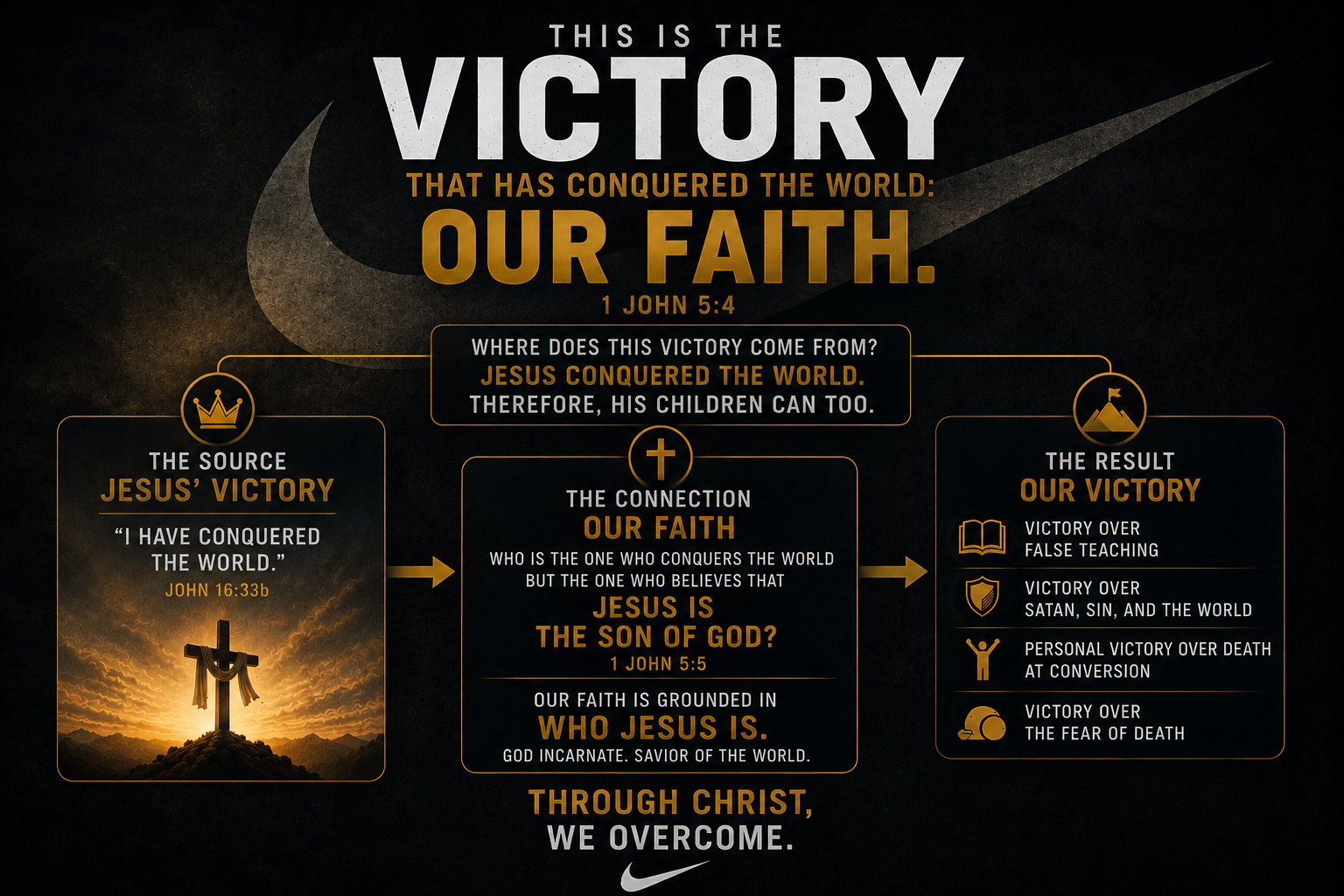
4. Genuine Faith Changes What We Overcome
John saves his biggest point for last.
“Everyone who has been born of God conquers the world.” (1 John 5:4)
The “world” in John’s writings refers to the values, temptations, and spiritual opposition that stand against God.
On our own, we can’t overcome those forces. But because Jesus has already conquered the world, His followers share in His victory.
John reminds us:
“This is the victory that has conquered the world: our faith.” (1 John 5:4)
Through faith in Christ, believers experience:
Victory over false teaching
Victory over Satan, sin, and the world
Victory over spiritual death through salvation
Victory over the fear of death
The ultimate expression of that victory is found in Jesus’ resurrection and the promise of eternal life.
As Paul wrote:
“Death has been swallowed up in victory… thanks be to God, who gives us the victory through our Lord Jesus Christ!” (1 Corinthians 15:54–57)
Big Takeaway
Victory in Jesus doesn’t mean Christians never struggle.
It means sin, fear, and death no longer have the final word.
Many believers live as though fear, shame, and insecurity still own them. But Jesus has already broken their authority.
Because of Christ, we can live with confidence, assurance, and hope.
Genuine faith in Jesus changes what we trust, love, obey, and overcome.
This Week’s Challenge
Spend some time reading through one of the Gospels this week.
Ask yourself what your actions reveal about what you truly trust.
Look for tangible ways to love other believers.
Celebrate victories Jesus has already brought into your life.
Identify ways God’s commands have protected, guided, and blessed you.
Reflective Question
How has following Jesus changed what you trust, love, obey, and overcome?
Fear Doesn’t Rule. God Does.
Why Does Fear Still Have So Much Power Over Me?
Scripture Covered
1 John 4:16–21 (CSB)
2 Timothy 1:7 (CSB)
John 15:12 (CSB)
Fear is everywhere right now.
Fear about our kids.
Fear about rejection.
Fear about health.
Fear about the future.
Fear fueled by social media, outrage culture, endless headlines, AI, uncertainty, and doomscrolling.
And if we’re honest, sometimes Christians feel an extra layer of shame on top of it all.
“If God is real…if His love is real…why do I still struggle with fear and anxiety?”
That’s exactly where the apostle John takes us in 1 John 4.
His answer is not, “Real Christians never feel fear.”
His answer is much deeper:
Fear doesn’t rule. God does.
1. God’s Love Is the Foundation, Not Human Love
John begins with this powerful reminder:
“And we have come to know and to believe the love that God has for us. God is love, and the one who remains in love remains in God, and God remains in him.”
— 1 John 4:16 (CSB)
That sounds beautiful, but it’s also difficult for many people to truly believe.
Why?
Because we often interpret God’s love through the lens of human love.
And human love can be inconsistent.
Transactional.
Performance based.
Manipulative.
Conditional.
Flippant.
“You do this for me, and I’ll do this for you.”
Human love often says:
“I’ll love you if…”
But God’s love is different.
God is holy.
God is faithful.
God is sacrificial.
God loves fully and completely.
That means if we want to understand love correctly, we cannot start with our experiences. We must start with who God is.
2. Perfect Love Drives Out Fear of Judgment
John continues:
“In this, love is made complete with us so that we may have confidence in the day of judgment, because as he is, so also are we in this world.”
— 1 John 4:17 (CSB)
Believers stand before God confidently, not because of their righteousness, but because of Jesus’ righteousness.
Christians approach God as forgiven children, not condemned enemies.
Then John says:
“There is no fear in love; instead, perfect love drives out fear, because fear involves punishment.”
— 1 John 4:18 (CSB)
In context, John is first talking about fear of death and judgment.
Without God’s forgiveness, death becomes terrifying. That’s why hospital rooms, funerals, and sleepless nights can feel overwhelming when someone doesn’t know where they stand with God.
But the Christian has confidence because Jesus has already carried the punishment for sin.
The Gospel changes how we face eternity.
3. God’s Love Also Changes How We Face This Life
John’s point doesn’t stop at eternity.
God’s love reshapes how we live now.
The apostle Paul told Timothy:
“For God has not given us a spirit of fear, but one of power, love, and sound judgment.”
— 2 Timothy 1:7 (CSB)
That does not mean Christians never feel afraid.
We will absolutely experience fear:
Fear about our children
Fear about relationships
Fear about finances
Fear about health
Fear about the future
But fear is no longer our master.
God is.
Christianity is not the absence of fear. It is living under a greater authority than fear.
That raises an important question:
Are your words, reactions, and outlook shaped more by fear or by Jesus?
Because fear is a terrible master.
God is far better.
4. God’s Love Should Flow Through Us
John then shifts from receiving God’s love to reflecting it:
“We love because he first loved us.”
— 1 John 4:19 (CSB)
Christians do not love others to earn God’s love.
We love because we have already received it.
That becomes the standard for every believer:
Do our actions toward others reflect the love of God, or do they contradict it?
John makes it personal:
“If anyone says, ‘I love God,’ and yet hates his brother or sister, he is a liar.”
— 1 John 4:20 (CSB)
That’s strong language, but John’s point is clear:
If we refuse to love people we can see, how can we claim to love God whom we cannot see?
This is not about struggling to love perfectly. Every Christian struggles.
The issue is an unwillingness to love.
Because God’s love changes people.
5. Christian Community Should Reduce Fear, Not Multiply It
John roots this command in the words of Jesus:
“This is my command: Love one another as I have loved you.”
— John 15:12 (CSB)
Not a suggestion.
A command.
That means:
We do not trash fellow Christians to make ourselves look better.
We apologize when we sin against others.
We forgive when others repent.
We do not casually discard people because conflict is uncomfortable.
Jesus is our model.
And honestly, no one has more reason to reject humanity than Jesus.
Humanity rebelled against Him.
Mocked Him.
Rejected Him.
Crucified Him.
And yet He still loves, forgives, corrects, and calls people back to Himself.
That is the model Christians are called to imitate.
John keeps emphasizing Christian community because believers are meant to become a visible reminder of God’s love in a fearful world.
The church should function like a rescue rope in rough water.
When people are drowning in fear, anxiety, shame, and discouragement, Christians should be the ones throwing ropes toward each other, not pushing one another further under.
That is part of what makes Christian community so powerful.
Big Takeaway
God’s indwelling love combats fear in three important ways:
It removes the fear of death and judgment
It weakens fear’s grip on everyday life
It works through God’s people as a source of strength and encouragement
Fear may still appear.
Anxiety may still creep in.
Insecurity may still surface.
But Christians are not abandoned to those things.
We know God’s love.
We know God’s people.
And we know this truth:
Fear doesn’t rule. God does.
This Week’s Challenge
What fear, anxiety, or insecurity do you need to bring honestly before God?
Are your conversations and reactions being shaped more by fear or by trust in Jesus?
Is there repair work you need to do with another Christian?
Are you helping strengthen people with God’s love, or stirring up more fear and outrage?
Have you trusted Christ personally, or are you still trying to face fear and eternity alone?
Reflective Question
If fear has been driving your thoughts, decisions, or relationships lately…what would it look like to place God back in the driver’s seat?
God’s Love Was Never Meant to Stop With You
Guest Speaker Jay Continued Our 1 John Series
Scripture Covered
1 John 4:7-16
Romans 5:8-10
John 13:35
Luke 6:32, 35
Romans 10:9
Galatians 5:22-23
This Sunday, Jay continued our series through 1 John by exploring one of the clearest evidences of genuine faith: love that looks like Jesus.
Building off last week’s message about the marks of real faith, Jay focused on what happens when God’s love truly takes root in someone’s life. His main idea challenged all of us:
God’s love abiding in us requires us to love others, especially those who don’t deserve it.
That sounds inspiring until it becomes personal.
Love Is More Than Emotion
In 1 John 4, the apostle John reminds believers that love is not merely an emotion, personality trait, or vague spiritual idea. Love originates with God because God Himself is love.
Jay unpacked the significance of that statement carefully. John does not simply say that God is loving. He says God is love. That means real biblical love cannot be separated from God’s character and nature.
John then makes the implication unavoidable: if someone continually refuses to love others, something is spiritually wrong.
This is not about sinless perfection. It is about transformed direction.
Real faith changes how we treat people.
God’s Love Is Different Than Human Love
One of the central passages in the message came from 1 John 4:10:
“This is love: not that we loved God, but that he loved us and sent his Son as an atoning sacrifice for our sins.”
Jay highlighted how different God’s love is from the way humans naturally love.
Human love often becomes conditional or transactional. We tend to love people who affirm us, agree with us, benefit us, or treat us well.
But God loved us while we were still sinners and separated from Him. The Holy Bible
That completely reframes Christian love.
Followers of Jesus are not called merely to love easy people. We are called to love undeserving people because that is exactly how God loved us.
The Church Is Meant to Reflect God’s Family
Jay also painted a compelling picture of what the church is supposed to be: people from different backgrounds, generations, personalities, and life experiences gathered together under one Savior.
That matters because people walk into church every week carrying loneliness, shame, anxiety, exhaustion, fear, and disappointment. God often uses the love, encouragement, and presence of other believers to sustain His people.
One of the most memorable illustrations compared believers to fruit trees.
Fruit trees do not produce fruit for themselves. The fruit exists for others.
In the same way, the fruit the Holy Spirit produces in believers is meant to nourish the people around them. Love, kindness, patience, gentleness, and encouragement are all intended to flow outward into the lives of others.
The Sea of Galilee and the Dead Sea
Jay closed with a visual illustration that tied the entire message together powerfully.
The Sea of Galilee flows into the Jordan River, which flows into the Dead Sea. Unlike the Sea of Galilee, nothing flows out of the Dead Sea. As water evaporates, minerals remain behind, creating an environment too salty to sustain life.
Same water. Different result.
The point was unforgettable:
God’s love was never meant to stop with us.
If we only receive grace, teaching, encouragement, and love without letting it flow outward toward others, our spiritual lives eventually become stagnant.
God’s love becomes complete in us when it flows through us.
This Week’s Challenge
This week, intentionally let God’s love move through you toward someone else:
Encourage someone who feels isolated
Forgive someone who hurt you
Serve someone who cannot repay you
Reach out to someone outside your normal circle
Pray for someone you struggle to love
Show kindness without expecting anything back
Do not wait until someone deserves it.
That is not how God loved us.
Reflective Question
If God loved you while you were undeserving, who might He be calling you to love differently this week?
Five Ways to Identify Genuine Faith
1 John’s Tests for Real Christianity
Scripture Covered
1 John 1:5-10
1 John 2:3-6
1 John 3:10-20
1 John 4:1-6
After taking a short break from 1 John, we jumped back into one of the clearest and most practical books in the New Testament. John writes to Christians struggling to separate real faith from false faith, and he gives several “tests” that help believers evaluate whether their faith is genuine.
But here’s the important reminder: John’s goal is not to make sincere Christians spiral in fear. These tests are meant to reassure real believers, not just expose false ones.
Real faith is not about perfection. It is about direction.
Throughout the message, we looked at five marks of genuine faith from 1 John:
1. Real Faith Walks in the Light and Takes Sin Seriously
John reminds us that “God is light, and there is absolutely no darkness in him.” Real Christians do not pretend sin is not real. They do not defend it, excuse it, or celebrate it. Instead, they bring it into the light through confession and repentance.
The good news is that confession leads to freedom, not shame. God does not call us to hide from Him but to walk honestly with Him.
2. Real Faith Obeys Jesus
John says, “This is how we know that we know him: if we keep his commands.”
Obedience does not earn salvation, but it does reveal loyalty. Genuine faith produces a growing desire to listen to Jesus, follow Him, and align life with His truth rather than drifting into spiritual apathy.
3. Real Faith Loves Others, Especially Other Christians
Christian love is not merely sentimental or verbal. John points us to Jesus laying down His life as the model for how believers should care for one another.
In a world that often feels hostile, lonely, and divided, Christian community becomes a lifeline. Real faith produces tangible love, compassion, generosity, and support for others.
4. Real Faith Trusts God Over Feelings
Feelings are real, but they are not ultimate truth.
John acknowledges that our hearts can condemn us. Shame, guilt, failure, and fear often distort how we see ourselves before God. But John reminds believers that “God is greater than our hearts.”
Real faith learns to lean into God’s truth instead of being controlled by emotional instability or self-condemnation.
5. Real Faith Learns to Discern What Is Actually True
John warns believers not to believe every spiritual voice they hear. Not everything spiritual is true, and not every popular voice is trustworthy.
In a culture flooded with social media, influencers, AI content, fear-driven news cycles, and competing “truths,” Christians must learn discernment. The voices shaping our hearts matter.
The world listens to the world. God’s people learn to listen to God.
The Big Takeaway
At the end of the day, John is not pointing people toward becoming impressive enough for God. He is pointing them back to Jesus again and again.
Real faith is not perfect people pretending they never struggle.
Real faith is people who:
Keep walking toward the true light
Confess sin instead of defending it
Trust Jesus more than themselves or the culture around them
Keep growing in love, obedience, and discernment
This Week’s Challenge
Pick one area from the message and act on it this week:
Practice confession and repentance
Reduce unhealthy screen time
Reach out to another believer
Forgive someone
Identify an area where feelings are leading more than truth
Faith grows when it moves from information to action.
Reflective Question
If someone looked at the direction of your life, what evidence would they see that your faith is real?